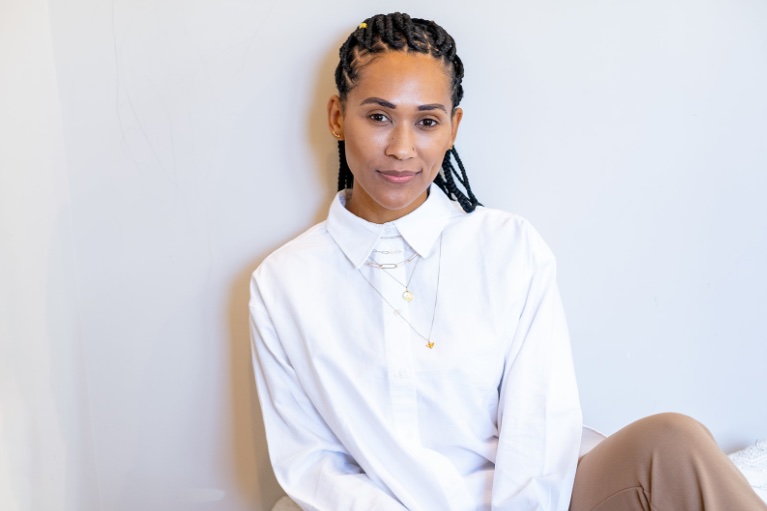

South African Musician Tsholofelo on Healing, Surrender, and Becoming
Some artists spend years trying to find their sound. Others spend years finding themselves.
For South African singer-songwriter Tsholofelo, those journeys became one and the same.
Her sophomore album, Burning Bush, is more than a collection of songs—it is the sound of transformation. Written over three years during a season of grief, healing, uncertainty, and rediscovery, the project captures what it means to surrender old versions of yourself in order to become who you were always meant to be.

Stripped back to its essentials—voice, acoustic guitar, and deeply personal storytelling—the album marks a striking evolution from her debut. Where Becoming introduced an artist finding her footing, Burning Bush reveals a woman with remarkable clarity, creating from a place of honesty rather than expectation.
Its title draws on the biblical image of fire not as destruction, but as refinement. Like gold tested in flames, Tsholofelo’s songs explore the difficult but necessary process of letting go, trusting the unknown, and allowing life’s hardest seasons to shape something stronger.
At a time when the music industry rewards speed, visibility, and constant reinvention, Tsholofelo has chosen a different path—one rooted in patience, intentionality, and artistic integrity. Her work doesn’t ask listeners to consume emotion. It asks them to sit with it.
In this interview, Tsholofelo reflects on the spiritual journey behind Burning Bush, the discipline of protecting her creative vision, and the profound transformation that happens when we stop resisting the fire and begin trusting what it is refining within us.
Read Our Interview with Tsholofelo
Burning Bush feels deeply spiritual without necessarily presenting itself as a religious project. I’m curious about your relationship to spirituality during the making of this album. Did the project emerge from a period of breaking down, becoming, healing, or awakening in your own life?
Tsholofelo: The project emerged from a period of healing—or perhaps more accurately, a recognition that healing was necessary—and a period of breaking down.
It began when I wrote Past Two Years in 2022, processing the impact of the COVID years alongside my own experiences of loss and grief. By 2023, when I intentionally began developing Burning Bush as a full album, one demo at a time, I found myself confronting a lot of questions about my life.
Before and throughout the recording process, I was trying to understand who I was and who I was becoming. It felt as though there was a veil between my present self and the future version of myself I hoped to grow into, and each song brought me a little closer to her.
In many ways, the album required me to burn away old versions of myself, expectations I had carried, timelines I thought I should have met, and ideas about who I believed I needed to be by now.
I had to radically accept where and who I was while still trusting where I was headed. That kind of surrender can feel frightening at first, but it ultimately became one of the most transformative aspects of making the record.
The process of creating Burning Bush marked the beginning of both my healing and my rediscovery. The music became a space where I could confront myself honestly, let go of what no longer served me, and begin imagining new possibilities for who I could become.

There is a remarkable emotional restraint throughout the album. Even in moments of vulnerability, nothing feels performative or emotionally excessive. How do you personally navigate the tension between revealing yourself through art and still protecting parts of your inner world?
Tsholofelo: The songs are for me before they are for anybody else.
A song like Burning Bush, for example, took me months to be able to play without breaking down. These songs were healing me and holding me in real time. By the time I entered the studio, I had already moved through the messy middle, the joy, the grief, and whatever emotions the song needed to work through in me first.
From that point, I’m able to sing the songs in a way that gives the listener space to have their own experience. I don’t feel the need to demonstrate how they should feel or guide their emotional response. Instead, I try to create enough honesty and openness for them to bring their own story to the music.
I also think emotional honesty is what creates that balance between revelation and restraint. As a listener, I can be inspired by many different sounds, emotions, and experiences, but as a creator, I have to be disciplined enough not to become noisy.
Learning how to balance experimentation with restraint is a skill that takes time, and it was something both my producer and I learned throughout the making of this album.
At the end of the day, I was simply trying to tell the truth as clearly as possible. Sometimes that means revealing something deeply personal, and sometimes it means knowing what to leave unsaid. Both are important parts of storytelling.

Your work feels intentionally slow and reflective in a cultural moment that often rewards immediacy, overstimulation, and constant visibility. Has protecting your artistic pace required resistance?
Tsholofelo: To some degree, yes, it has required resistance.
I think to make good music—something that you can be proud of—you need a certain defiance, particularly within the music industry and popular culture.
I think it was Joni Mitchell who said, “A total unwillingness to cooperate is what is necessary to be an artist—not for perverse reasons, but to protect your vision.” And I completely agree.
There have been moments where I’ve felt like speeding up the pace and have felt impatient, but I now know magic doesn’t happen that way.
Many women artists are expected to package vulnerability into something easily consumable. Your work feels more contemplative than consumable. Was it important for you to create music that asks listeners to sit still and truly feel?
Tsholofelo: Yes, that was important to me because I had to sit still and feel in order to make the album.
The songs came from a place of genuine reflection, and I can only create from an honest space. I wasn’t interested in packaging emotions into something easily digestible; I was interested in understanding them and allowing them to unfold naturally through the music.
I think that honesty is what gives music its longevity. When a song is rooted in real human experience rather than a particular trend, moment, or cultural conversation, it has the potential to outlive all of those things. It can continue to resonate because it speaks to something fundamentally human.
If Burning Bush asks anything of the listener, it’s simply your presence.
The title Burning Bush evokes both destruction and revelation. What did that metaphor come to represent for you personally by the end of the project?
Tsholofelo: “Destruction and revelation” actually puts it quite aptly.
By the end of this project, the metaphor came to represent a journey—a journey through transformation, womanhood, and hope.
In this album, the central motif that emerges is fire and the refinement of oneself through fire. Like gold going through the refinement process, one must go through the fire, where flames that could consume you do not but instead purify and refine you.
You come out better on the other side, and that’s essentially the theme of the album and what I’m trying to convey.
At the time of creating this album, I had been going through fires of my own but held onto the promise of who I was becoming through this process of refinement. All I needed to do was surrender and trust the process.
Biblically, the story of Moses truly begins at the Burning Bush—that’s where his journey begins. In many ways, the journey of this album, and perhaps even my professional career as an artist, begins with my own Burning Bush.
What does artistic integrity look like to you in this current era of visibility, algorithms, and performance culture?
Tsholofelo: It looks like sticking to your guns about who you are, firstly, and about how you choose to express yourself artistically.
It’s tough sometimes to resist the need or desire to fit into an already existing mold. Forging your own path is difficult, but it’s also the most fulfilling journey because there is no pretense.
It’s also remaining committed to your vision, even when it doesn’t fit neatly into what is expected or popular, and making decisions based on what feels honest rather than what feels strategic.

When you look back at the woman who began this album and the woman who completed it, what changed most profoundly within you?
Tsholofelo: I have gained a sense of confidence and clarity I did not have before. I think that is what has changed the most within me.
For a person who, between 2020 and 2021, had actually tried to walk away from making music entirely, to a woman who is sure of herself and her artistry and unafraid, there has been a significant shift.
My best friend and producer, Thando Kunene, and I can really look back at what we’ve created with a sense of pride, and we’re both very different artists now than we were three years ago.
Everything feels clearer now: the stories I want to tell, the emotions I want to sit in, and the kind of artist I’m becoming.
The woman I am now feels less uncertain, even if the journey itself is still unfolding.
Click here to listen to Tsholofelo’s album